
The Machine That Tells You What You’re Allowed to Know
Artificial Intelligence (AI) is not the real danger. The danger is a government-approved machine quietly teaching citizens what counts as truth.
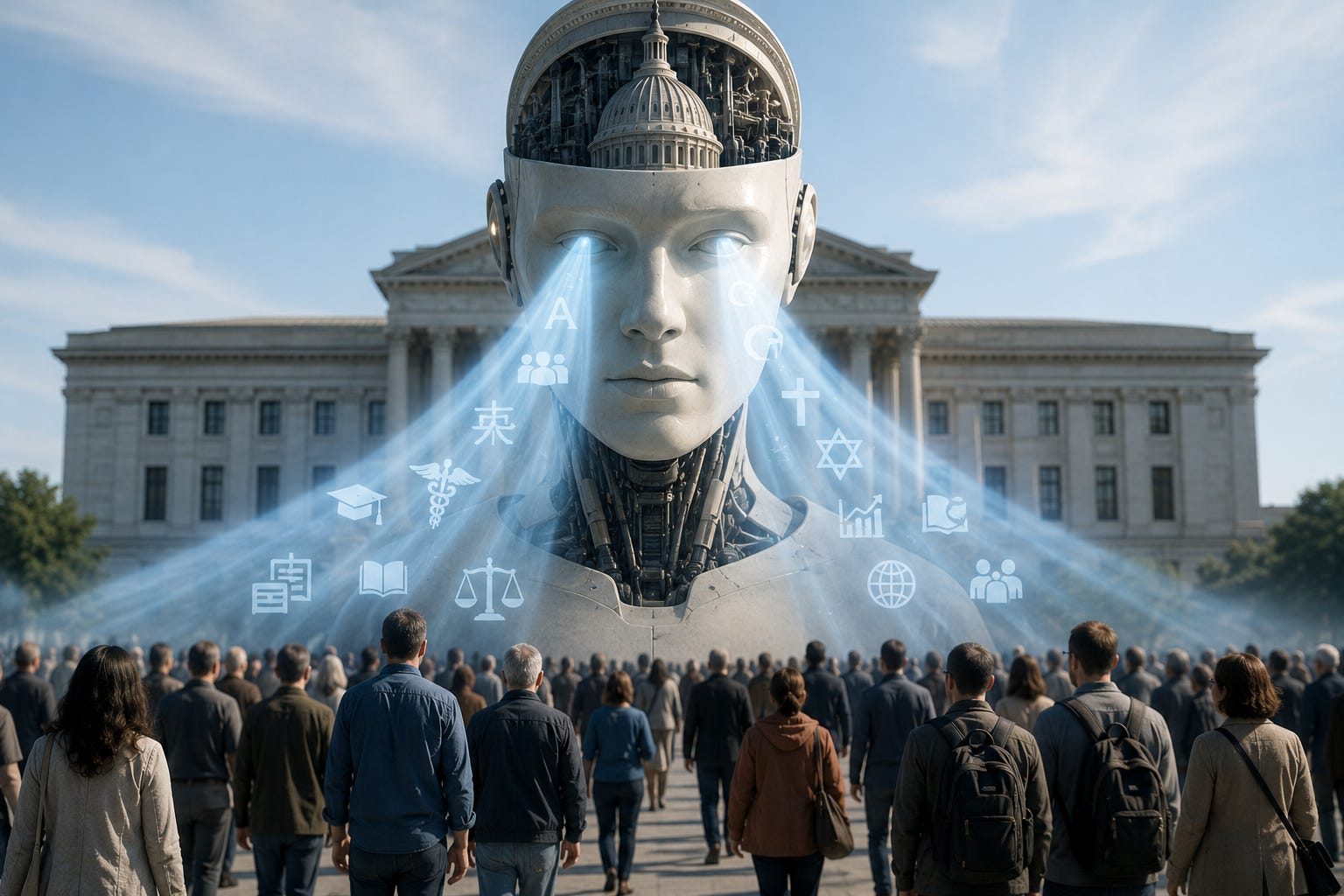
The facts are not imaginary. The federal government is already moving deeper into artificial intelligence use. The Office of Management and Budget (OMB) has directed agencies to accelerate adoption while managing risk. The Government Accountability Office (GAO) says federal agencies are expanding generative AI use. The White House has also issued policies aimed at shaping what counts as “unbiased” AI for federal procurement.
That does not mean every government AI tool is propaganda. That would be too easy, and life rarely hands us villains who arrive already wearing the cape.
It does mean citizens ought to keep both eyes open and one hand on their wallet, because “official truth” has a long and colorful history of arriving with a flag pin and a straight face.
You can picture the small moment easily enough. A man sits at the kitchen table trying to understand a Social Security problem, a Medicare denial, a veterans benefit issue, or a new rule from some agency whose name sounds like it was assembled by committee during a power outage. He asks the official government AI assistant a simple question.
The answer comes back clean, confident, polite, and wrapped in the comforting tone of a young consultant who has never had to argue with a billing office.
The question is simple: who taught the machine what to say?
That is where the whole thing gets less cute. The danger is not that AI “thinks.” It does not sit in a basement reading Plato and plotting against the republic. The danger is that AI is trained, tuned, filtered, approved, and deployed by institutions with interests.
Government is not just another user of AI. Government writes rules, controls benefits, defines categories, issues guidance, awards contracts, and decides what language is acceptable inside its own machinery.
So when government starts using AI as a front door for public information, the issue is not merely whether the machine makes mistakes. It will. The New York City business chatbot famously gave wrong and even unlawful advice to business owners, which is exactly the sort of thing that happens when officials discover a shiny new tool and immediately decide the public should help beta-test it.
Nothing says “public service” quite like making citizens serve as unpaid quality control.
But the deeper issue is not error. Error can be found, corrected, audited, and explained. The deeper issue is authority.
Once an AI system becomes the official voice of an agency, its answers begin to feel like policy even when they are not. Most citizens will not know whether they are reading law, guidance, interpretation, habit, political preference, or a machine’s smooth little hallucination wearing a government nametag.
Around the table, someone will say, “Well, we need standards. We can’t have biased AI.”
Fair enough. Nobody wants a government chatbot freelancing like a drunk substitute teacher. The National Institute of Standards and Technology (NIST) created its AI Risk Management Framework because AI systems can create risks involving bias, reliability, privacy, transparency, and public trust. That is not hysteria. That is basic adult supervision, which is apparently now a scarce commodity requiring a federal framework.
But here is the problem: when politicians say “unbiased,” they often mean “biased in the way I approve of.” That is not a left-right problem. That is a power problem.
The current White House policy says federal AI systems should avoid ideological bias and pursue objective truth. Lovely words. Frame them. Put them in the lobby. But the hard question remains: who defines ideological bias, who defines objective truth, and what happens when the next administration changes the answer?
That is where this becomes bigger than Social Security forms and bureaucratic runaround. A government-shaped AI does not just answer benefit questions. It can shape how citizens understand history, science, religion, public health, immigration, war, policing, education, climate, disability, race, gender, voting, and the meaning of rights.
Not always through crude censorship. Usually through something quieter - what gets emphasized, what gets softened, what gets omitted, what gets labeled fringe, what gets treated as settled, and what gets buried under “more context.”
That is the real machine. Not the chips. Not the servers. Not the chatbot window.
The real machine is the chain of decisions behind the answer: training data, procurement rules, safety filters, political instructions, agency priorities, contractor incentives, and bureaucratic fear. By the time the citizen sees the answer, the argument may already be over. The machine does not have to ban a view. It can simply make that view harder to find, harder to phrase, and easier to dismiss.
And let’s not pretend private companies are innocent little lambs here either. They bring their own incentives, training choices, blind spots, and corporate survival instincts. But when private AI gets something wrong, citizens can criticize the company, switch tools, or compare answers.
When the government-approved system becomes the official pathway to public knowledge, the imbalance changes. The citizen is no longer just talking to software. He is talking to software backed by authority.
What does this lead to? A softer kind of control. Not jackboots. Not book burnings. Something more modern and respectable, which means it will arrive with a dashboard, a procurement memo, and a panel discussion full of people using the word “stakeholder” until the wallpaper peels.
It leads to citizens who stop asking hard questions because the official system already gave them “the answer.” It leads to agencies hiding behind AI outputs while pretending no human made the choices. It leads to politicians denouncing bias while building their own preferred bias into the plumbing.
And it leads to a public that becomes more dependent on official interpretation at the very moment it most needs independent judgment.
The lesson is not “ban government AI.” That is too easy, and frankly, too late. Government will use AI because every large institution uses any tool that promises speed, savings, and fewer people asking for a supervisor.
The real demand should be transparency, appeal rights, independent audits, public documentation, source disclosure, human review, and clear warnings when AI is summarizing rather than stating law.
A free people can use machines. A free people should not be trained by machines they cannot inspect, challenge, or escape.
That is the line. AI is not the monster under the bed. The danger is official intelligence - polished, centralized, politically trained, and presented as neutral truth.
We have seen this trick before. The only new part is that this time the mouthpiece can answer in complete sentences.
_________
Sources
https://www.gao.gov/products/gao-25-107653
https://www.nist.gov/itl/ai-risk-management-framework
https://apnews.com/article/6ebc71db5b770b9969c906a7ee4fae21
_____________________________
Also from me: For my focused writing on autism, developmental disabilities, Medicaid, and the safety net, visit Safety Net Watch at safetynetwatch.substack.com
______