
One Thread Among Billions
Seeing Ourselves as Part of Life’s Kaleidoscope, Not the Center
🎧 Prefer to listen? Hit play below for the audio version of this post.
Let’s be honest: if humans had a family crest, it would say, “We’re different. Trust us.” We strut around like we’re the headliners at Earth’s big variety show - main act, VIP passes, maybe even a backstage deli tray with our name on it. But step outside your own story and really look at nature, and you’ll see that life’s greatest hits aren’t just a human playlist. In fact, most of what we do, someone else on this planet did first - and sometimes did it better.
Take whales, for example. These gentle giants have family groups, languages, and even traditions that get passed down through generations - one pod might sing a completely different song from another, and yes, they teach their kids the family tune. But it’s not all peaceful under the waves. Sperm whales have been known to fight bitter, violent wars with orcas, and rival pods sometimes clash over territory. These “wars” can last for generations, echoing the grudges and alliances that shape our own history. Next time your relatives won’t let go of a grudge from 1986, just remember: somewhere, a sperm whale is probably still mad about a squabble from the Reagan years.
That sense of family, adaptability, planning, emotion, and even thoughtfulness - it shows up everywhere in the living world, not just with the big, showy animals. Ants farm fungus like little agricultural tycoons. Crows solve puzzles and hold grudges that make high school drama look tame. Fish change sex to fit social needs. Slime molds figure out mazes. Trees “talk” through root networks, which makes your neighbor’s nosy group texts look pretty basic.
It’s not just about survival of the fittest or the biggest. It’s survival of the connected - the ones who can adapt, form bonds, help or even forgive. We see little fish cleaning big ones, bats sharing food, tiny birds mobbing a hawk to protect their own. Even plants cooperate - sharing resources or warning each other about threats. Everybody’s got each other’s back, or at least a leafy equivalent.
Now, meet the naked mole rat: living proof that office politics didn’t start with humans. These critters build underground cities with a queen, workers, and soldiers. Don’t pull your weight? You’ll get a bite on the behind. “Family values”? Mole rats have been enforcing them longer than we’ve had office coffee machines.
Crows - never underestimate a bird with a grudge. They recognize faces, warn their friends about “bad humans,” and can keep a neighborhood feud going for years. Their gossip network makes the town busybody look like an amateur. If you think family group chats get out of hand, you haven’t seen a crow convention.
Think we invented mourning and memory? Elephants visit the bones of their dead, caressing them with their trunks. They comfort the grieving and teach the young to pay their respects. Prairie dogs have regional dialects (imagine prairie dog accents). Dolphins name each other and form cliques - yes, there’s a cool dolphin table in the cafeteria. Chimpanzees use tools, teach their kids, and wage coordinated wars - brutal attacks against neighboring groups. Jane Goodall, who first documented these “chimp wars,” was shocked - she once believed, like many of us, that such cruelty was a human invention.
And don’t think animals are above the nastier side of conquest. Ants are notorious for raiding rival colonies, kidnapping the young, and turning them into workers - literal slavery. Dolphins, for all their charm, have been caught tormenting porpoises and forming cliques that bully outsiders. Baboons patrol their borders, attack rivals, and show favoritism based on family lines, coat color, and other differences. Even birds have been caught excluding newcomers, harassing the “wrong” kind, and playing favorites within their flocks. The next time you feel left out of a group, remember - it happens in the jungle, too.
Even the daily grind - the work, the routines, the drama - looks pretty familiar in the wild. Bees organize their whole lives around jobs, teamwork, and communication. Ants farm fungus and herd aphids. And don’t get me started on the dating scene - bowerbirds build elaborate “mansions” decorated with blue treasures to impress potential mates, and if a rival trashes the place, it’s back to square one. Love is tough all over.
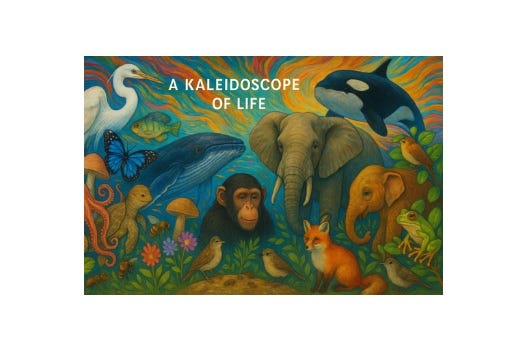
It makes the whole thing feel less like a ladder and more like a living tapestry - a kaleidoscope.
Every turn, something new. All these different forms of life, from bacteria to elephants, fit together in a pattern that’s always shifting, always surprising, sometimes rough but also full of beauty. And, honestly, a little comedy.
If we saw ourselves as part of that kaleidoscope - not the centerpiece, but one shining bit among billions - it might help us find a little more respect for the rest of life, and maybe even for each other.
So, why do we seem to “swim against the current”? Maybe it’s because we’re both animals and dreamers. We’re part of nature’s order, but also always questioning it. The “natural order” for most life is simple and adaptive - go with the flow, fit the niche, keep the group alive. For humans, the “order” is messy, aspirational, and full of struggle - because we can imagine more than what just is.
Now, here’s where humans are different. We’ve got bigger brains, more complex emotions, and the ability to imagine different futures. That’s a double-edged sword. On one hand, it lets us cooperate in huge numbers - far beyond what any other species can manage. On the other, it means we argue about values, beliefs, who gets to be in charge, and what’s “fair.” Our brains are wired for stories, opinions, and meaning. So instead of just following instinct, we invent systems - governments, economies, laws, religions. These are attempts to organize ourselves, but they’re always bumping up against our differences.
Long story short, we’re complicated on purpose. It’s frustrating, sometimes tragic, sometimes just plain ridiculous - but it’s also why we’ve built so much - art, science, cities, and yes, all those messy governments. It’s the human condition: part of the flow, but always restless, always asking “what if?”
The truth is, life on this planet is improvisational, communal, and sometimes a little bit absurd. Whether you’re a mushroom networking underground or a person sitting in rush hour, you’re living out the same story: trying to survive, connect, protect your own, and find a little joy along the way.
But let’s not forget - this wild, tangled web isn’t all rivalry and rough-and-tumble. Look close, and you’ll see tenderness and love woven just as deeply. Across the animal kingdom, kindness and sacrifice are everywhere, sometimes in the most unexpected places.
Take elephants again: they’re famous for their compassion. Herds have been known to rescue calves from mud pits, protect injured adults, and even stand vigil with a dying family member. A mother will defend her calf against a lion, risking her own life without a second thought.
Or watch dolphins - highly social, always up for play, but also helpers. They’ve been seen nudging sick friends to the surface to breathe, forming a circle to protect a wounded member, or even coming to the aid of swimmers and other species in trouble.
Birds, too, have their moments. Ravens have been observed calling for help when one of their own is trapped, and other ravens will arrive - sometimes from miles away - to try to free their comrade. Tiny birds mob much larger predators to drive them off and keep their community safe.
And it’s not just family ties. Sometimes these acts of care leap right over the boundary between species. Dogs adopt orphaned kittens. A gorilla cradles a wounded bird. Fish form cleaning stations where shrimp and small fish pick parasites off bigger fish - no fighting, just a mutual benefit. Even in the wild, sometimes a neighbor brings over the casserole.
Insects can surprise you, too. Bees, for all their busy-ness, will cluster around a shivering hive mate to keep her warm. Ants carry injured companions back to the nest, treating wounds and feeding them until they recover - behavior that would look right at home in any human hospital.
Love and connection don’t always look like ours, but they’re out there: penguin couples sharing chick-raising duties, vampire bats sharing blood meals with the hungry, whales traveling thousands of miles to reunite with their kin. There’s self-sacrifice, too - parents risking or giving their lives for their young, soldiers defending their colony, flock, or herd with everything they’ve got.
And then there’s play - pure, joyous, sometimes downright silly. Otters slide down muddy riverbanks for fun. Crows make toys and invent games. Even octopuses toss shells and play hide-and-seek. Play isn’t just a human privilege - it’s a universal language. If you thought recess was just for kids, try watching two goats invent a game of king-of-the-mountain, or a dog teaching a pig to play tag.
But let’s be real - nature’s full of tricksters, too. Birds fake injuries to lure predators away from their nests. Fish pretend to be the opposite sex to slip past rivals. Chimpanzees and dogs both “play dumb” to get out of trouble or to get a better treat. Deception and strategy are part of the dance, just like honesty and teamwork.
In every corner of the world, reward and recognition aren’t just human ideas, either. Wolves share food with the best hunters. Cleaner fish get extra protection from their “clients.” Ants get special treatment for good scouting. Even in the wildest places, good deeds don’t go unnoticed.
When you step back and really look, what you see isn’t a ladder with humans at the top. It’s a kaleidoscope - shifting, dazzling, full of patterns, colors, stories, and a lot of characters you wouldn’t want to sit next to at Thanksgiving.
We’re not alone. We never have been. We’re just one shining piece in a living mosaic, and if that doesn’t fill you with hope and humility, nothing will.
We don’t need to be the center of the story to make it meaningful. The miracle is that we’re part of it at all - just one of many, muddling through, sometimes failing, sometimes shining, always connected.
So let’s step down from the pedestal and join the party. Turns out, it’s a lot more interesting - and a lot more hopeful - when you realize you’re not alone. You’re just another story in life’s grand, ongoing, slightly messy, and totally amazing show.
___________________________

Brighten your week - A Story to Carry
Cut to the Chase
The Spider’s Thread
In a quiet corner of the meadow, a young spider spun her first web.
She admired it proudly, glistening with dew in the morning sun.
“Look at my masterpiece,” she said. “Surely, I am the center of this meadow.”
A bee buzzed by, too busy to notice. A sparrow darted through the air, chasing a fly. Even the grass swayed in its own rhythm, paying no mind to her shining web.
Irritated, the spider called out, “Can’t you see how beautiful I’ve made the world?”
The bee paused just long enough to say, “We all make the world, little one. Your silk is fine - but it’s one thread among billions.”
The spider watched the day unfold - the ants marching below, the flowers turning toward the light, the worms softening the soil. Each creature was part of something larger. Her web trembled in the breeze, and she saw how it shimmered only when the sun hit it with the rest of the meadow.
That evening, she wove again - not to be admired, but to belong.
Moral: We are not the pattern itself - only one bright thread in life’s great web.
_____________________________
_____________________________
This resonates. I'm sure you've seen the Jane Goodall documentary. It left me feeling pretty small and selfish in the great scheme of things. We humans think too much of ourselves, and the consequence is the world-wide mess we are living in today. And we all own it.
Thank you very much. -Woodrow