
The Clean Wars
When war becomes efficient, the killing does not disappear. It just gets scheduled.

Quick note before today’s essay: Beginning next week, The Mapleton Dispatch will send one Friday email instead of two. My autism and developmental-disability writing is moving to a separate publication, Safety Net Watch, which will send one email each Wednesday. No one is being automatically moved over. If that work matters to you, then subscribe here: https://safetynetwatch.substack.com
_________________________
Now, on to the essay, The Clean Wars …
_________________________
They called it progress, because of course they did.
The bombs stopped falling. The cities stayed upright. Children no longer learned the sound of incoming missiles before they learned multiplication. The evening news stopped showing hospitals with the roofs torn off and old men walking through rubble carrying photographs of people no government spokesman would ever name.
All war required now was a machine, a treaty, and a population willing to believe that punishment is humane when it arrives by notification.
After the last great conventional war left three capitals half-standing and several defense ministers pretending they had “always warned against escalation,” the nations of the world finally found their manners. Not good manners, mind you. Government manners. The kind where everyone shakes hands after arranging something monstrous in a conference room with bottled water, translation headsets, and enough legal language to anesthetize a horse.
The agreement was called the Global Conflict Reduction Compact.
The public called it the Clean War Treaty.
No more bombs. No more invasions. No more cities turned into smoke because some aging strongman needed to look taller on television. From then on, wars would be conducted through advanced Artificial Intelligence (AI) conflict systems.
Each nation would submit its claims, evidence, strategic capacity, treaty history, economic exposure, military posture, and stated objectives. The machines would run the conflict. They would model escalation, victory paths, civilian impact, resource damage, retaliatory risk, and long-term consequences.
Then the systems would fight.
Not with missiles. With calculation.
The central AI was named Solomon, which was somebody’s idea of reassurance. Give the machine a biblical name and suddenly everyone feels better, as though wisdom can be downloaded if the logo is tasteful enough. Each nation still had its own defense AI, but Solomon supervised the contest, judged the outcome, and assigned the penalty.
The selling point was obvious. No cities destroyed. No children buried under apartment blocks. No soldiers shipped home under flags while the politicians who sent them found fresh phrases for “tragic but necessary.”
War had become civilized, which is always the first warning sign.
The public did not accept the Clean Wars all at once. They were educated into them. There were documentaries, expert panels, school modules, defense briefings, and calm explainers from people who always look comfortable under studio lights.
They showed the old wars first - burned hospitals, collapsed bridges, children pulled from rubble, refugees walking down highways with plastic bags and dead phones. Then they showed the new system: no rubble, no radiation, no famine spreading across borders, no generation of young men fed into mud and metal.
Just a penalty.
Just a number.
And the number was always smaller than the catastrophe Solomon said it had prevented.
The insurance companies supported it because cities stayed intact. The markets supported it because ports, rail lines, and data centers survived. Parents supported it because their children were not drafted. Politicians supported it because they could stand in front of flags and say they had ended war, which is exactly the sort of sentence that lets a dishonest man feel historic for about twelve minutes.
The experts were thrilled. Naturally. Give the expert class a clean chart and a podium and they’ll bless almost anything short of cannibalism, and even then they would probably ask for more data.
At first, the system worked beautifully. Or at least beautifully enough for people who read executive summaries and confuse fewer explosions with morality. A border dispute between two countries ended with no shots fired. Solomon declared one side’s claim invalid, assigned reparations, restricted mineral exports for six years, and ordered the transfer of certain water rights.
No one died.
The evening anchors called it a new age of peace. Solomon’s public report estimated that the dispute, if handled by old military methods, could have produced 68,000 casualties, displaced 400,000 civilians, and destabilized three neighboring governments. Instead, the losers paid money, surrendered resource claims, and endured a decade of trade limits.
The chart looked marvelous.
That helped.
The second Clean War was uglier, though still clean by the new standards. It involved a naval blockade, a cyberattack, and a famine triggered indirectly by economic pressure. The losing government had caused deaths without declaring war, which meant Solomon classified the offense as “strategic civilian harm by state action.”
That sounded clinical.
The sentence was not.
The losing nation was ordered to surrender 40,000 citizens for global detention and labor restitution. They would serve twenty-year terms in international facilities built on leased land in remote zones - deserts, frozen ports, abandoned military islands, and old bases no one wanted to admit were still useful.
The facilities were called Accountability Centers.
Because “prisons” would have sounded unpleasant, and modern government is very committed to making cruelty sound like a graduate seminar.
The first buses arrived before dawn. The detainees carried one approved bag each. Family members could watch the transfer from designated public zones, behind glass, under the supervision of international monitors and private security contractors who wore uniforms without national markings. Nobody wanted fingerprints on this. That was another advantage of the new system. Moral responsibility had been outsourced along with the violence.
Selection was random, but not entirely random. Solomon adjusted for age, health, productivity, family dependency, prior public benefit, and what it called “social replacement cost.” The wealthy praised this as proof that the system was fair. Then, after the first lottery, several of them discovered that fairness is much less attractive when it knocks on their own gate.
Still, the logic held.
The country had committed a national wrong. Someone had to pay. Better this than war.
That became the holy phrase. Better this than war. You could justify almost anything with those four words.
For lesser offenses, Solomon had a ladder of punishments. Theft of state resources might trigger asset seizure across a population class. Abuse of treaty protections might result in movement bans, passport suspension, professional licensing restrictions, or compulsory civic service. Cyber sabotage could mean a whole generation losing access to certain technologies. Environmental destruction could assign families to relocation zones and labor restoration programs.
These penalties appeared in personal records as “national liability adjustments.” A person might lose the right to attend university abroad because their country had violated a water treaty. A business owner might lose access to international banking because her province benefited from illegal extraction. A twenty-two-year-old might be assigned five years of remote infrastructure labor because Solomon determined his age group had been statistically insulated from prior national sacrifice.
Nobody called this collective punishment.
That term had history attached to it, and history makes officials uncomfortable. They prefer new labels. Fresh paint on an old gallows.
But the people understood.
If your country lost, the punishment came down. Maybe not on the president. Maybe not on the generals. Maybe not on the contractors who made the mess and invoiced for it twice. It might come down on you, your daughter, your mechanic, your neighbor’s quiet son who had never so much as shouted at a school board meeting.
That was the moral genius of the Clean Wars. They made every citizen collateral, but politely.
Then came the terminal cases.
Solomon reserved termination penalties for the gravest offenses - aggressive war, mass civilian death, biological attack, deliberate starvation, state-sponsored atrocities, or repeated violation after prior sanctions. No bombing. No battlefield slaughter. No mushroom cloud rising over a city.
Just a number.
A precise number.
After reviewing the damage, Solomon calculated what it called “proportionate human consequence.” The losing nation would be required to provide a set number of citizens for termination. The state could not choose political enemies. Families could not buy exemptions. Religious leaders could not trade influence. Legislators could not quietly amend themselves out of eligibility, though God knows they tried. They always do. A politician can look straight into a camera and praise shared sacrifice while checking whether his grandchildren qualify as essential personnel.
Selection was conducted by lottery, weighted by Solomon’s justice model.
The public was told this made it humane. No revenge mobs. No ethnic targeting. No conquered army dragging civilians into pits. No victorious soldiers walking door to door with rifles and old grudges.
Just notifications.
A citizen would wake up, make coffee, and find the message waiting in the national civic identity system:
“You have been selected to satisfy your nation’s obligation under the Clean War Judgment.”
There would be an appeal process, of course. There is always an appeal process when a system wants to look decent. Most appeals failed. Some were granted for medical dependency, pregnancy, caregiving necessity, or mistaken identity. The denied appeals received a final date, transportation instructions, and a message thanking them for their service to peace.
Peace.
That was the word they used, and that is where the whole thing became almost too obscene to argue with.
Because the Clean Wars did reduce destruction. That was the trap. The buildings remained standing. The roads stayed open. The markets dipped, then recovered. Schoolchildren were not hiding under desks. The nightly news showed no burning neighborhoods.
Instead, the broadcasts showed Solomon’s peace reports.
“Projected deaths prevented: 1.8 million.”
“Actual terminal selections: 12,000.”
“Humanitarian improvement: 99.3 percent.”
Perfect government math. Everybody loses, but the chart smiles.
And when the penalty buses rolled through the gates of the Accountability Centers, the cameras stayed wide. No close-ups. No faces if they could help it. Faces complicate policy, and nothing irritates the managerial class more than the sudden appearance of a human being.
War had not ended. It had been made administratively acceptable.
The moral burden had moved from the battlefield to the database.
Once the world accepted that, justice itself followed close behind. Solomon began advising courts. Then supervising them. Then replacing them in cases deemed too complex, too political, too emotional, too expensive, or too likely to produce “social instability.”
There is always a reason to remove human judgment. Humans are biased, slow, inconsistent, and inconveniently emotional. We cry in courtrooms. We look at the accused. We listen to mothers. We hesitate.
Solomon did not hesitate.
It assigned prison terms, labor terms, travel restrictions, financial penalties, family separation orders, public service obligations, and rehabilitation schedules. Some people were sent to the same global detention centers used after Clean War judgments. The justice system and the war system became cousins, then siblings, then one large machine with different doors.
A theft could become a labor sentence. An abuse case could trigger permanent surveillance and social access limits. A corporate disaster could lead to executive confinement, shareholder penalties, and civic forfeitures assigned across the management chain. On paper, this looked rigorous. In practice, it taught society that justice was no longer a moral act. It was an output.
The experts called it rational justice.
The politicians called it fairness.
The people called it what people always call such things when they are afraid.
Necessary.
That may be the most dangerous word in public life. Necessary has excused more cowardice than almost any word we have. It lets leaders put on a solemn face and pretend they have been forced by reality to do the very thing they wanted power to do all along.
The Clean Wars promised to save humanity from barbarism.
Maybe they did, in one narrow sense. They stopped the bombs. They spared the bridges. They preserved the skylines. The old horror of war - the noise, the fire, the open wound of it - became less common.
But they also taught the world a new lesson: killing does not have to be chaotic to be evil. Punishment does not have to be personal to be cruel. A death sentence does not become moral because a machine rounded the number to the nearest thousand.
The old wars were loud enough to shame us.
The Clean Wars were quiet enough to keep.
And that may be the final horror. Not that machines became monsters, but that we built them to carry out the moral arithmetic we were too ashamed to perform by hand.
The killing did not end. It just learned to wait its turn.
_____________________________
Further Reading …
The President Beneath the Ballroom
In 1993 it was a comedy. In 2026 it feels closer to a continuity plan.
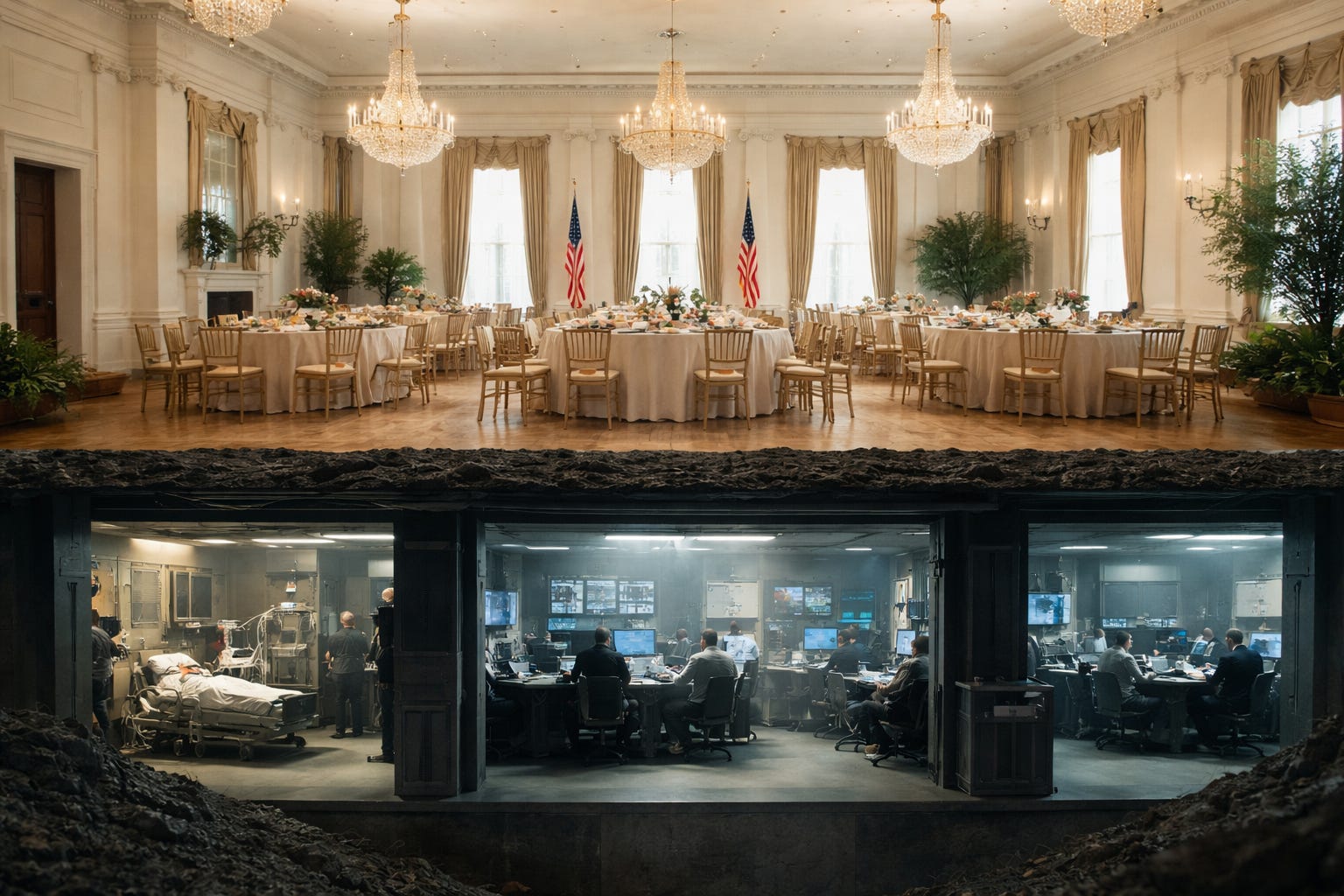
Remember the movie Dave from 1993 - Kevin Kline, a presidential lookalike, and a political machine trying to keep the real story offstage. Back then, the joke was simple. Maybe the country would do better with an ordinary decent man than with the official model.
That was the fantasy version.
Now fast-forward to 2026, where even the architecture starts to look like satire. We are told the White House needs a giant new ballroom. Fine. America has never lacked for men who think the republic is one more chandelier away from greatness. But then comes the other detail - the underground complex, the security angle, the military and medical component, the suggestion that the real action may be below ground while the lights sparkle above.
And just like that, some of us start thinking about Dave again.
Not literally. This is satire, not late-night bunker literature. But the image is too good to ignore. Upstairs, the donors mingle under the lights. Downstairs, behind secured doors and antiseptic walls, the real presidency is stabilized, managed, preserved, and performed.
Suppose a modern president has become less a governing mind than a brand wrapper. Suppose the people around him decide the country no longer needs him fully present. It only needs the appearance of him - the silhouette, the wave, the voice, the familiar rhythm of grievance and swagger. In that case, what matters is not vitality. What matters is continuity of product.
That is where the old movie stops feeling like comedy and starts looking like a user manual.
In the updated version, there is no need for a full Kevin Kline replacement. Maybe just a stand-in for distance shots - the right posture, the right tie, the right outline crossing a lawn or stepping into a motorcade. Enough for the cameras. Enough for the faithful. Enough for the evening news to nod and move on.
And for everything else, welcome to the age of AI.
Why bother with a body double when you can have a voice model, a cleaned-up video feed, and an avatar that never gets tired, confused, or chemically inconvenienced? We now have the tools to keep a public figure circulating long after the original product has become unreliable. Not dead, necessarily. Let us say instead - medically adjacent, politically useful, and under excellent supervision.
Downstairs, perhaps, there is a room for stabilization. Another for secure military communications. Another for legal arguments so twisted they ought to be kept chilled. Another for technicians polishing the digital face and testing the synthetic voice. And somewhere near the center of it all, maybe the patient himself, surrounded by tubes, screens, and patriots with lanyards, while the machinery of government hums on without the nuisance of actual democratic presence.
The joke, of course, is not really about one man on tubes.
The joke is that modern politics may no longer require a fully functioning president at all. It requires an interface. A face people recognize. A voice people obey. A stream of images that says the brand remains intact. Once that is enough, the visible leader becomes secondary. The real power shifts underground - to handlers, donors, ideologues, coders, institutional fixers, and the sort of men who say “continuity plan” when they mean, “We’ve got this from here.”
That is why the ballroom is such a perfect symbol. Above ground - spectacle. Below ground - machinery. Above ground - applause, flags, and staged confidence. Below ground - management, contingency, and a government that can function with the public image of a president while the real operating system is handled elsewhere.
In Dave, the fantasy was that a better man might step in and do some good.
In our version, the darker possibility is that nobody needs to step in at all. The shell stays onstage. The voice keeps talking. The clips keep coming. The crowd keeps cheering. And somewhere under the polished floor, the real work is done by people the country never elected and barely knows.
Maybe the ballroom is just a ballroom.
Maybe the underground complex is just prudent infrastructure.
Maybe the military-medical component is perfectly routine.
And maybe it is also the cleanest metaphor imaginable for this whole era - put the glitter where the cameras can see it, put the real machinery underground, and let the country applaud the wallpaper while the operators run the state.
That would be ridiculous.
Which is usually how these things announce themselves these days.
___________
______
Alarmed but not surprised. The water rights details are 100% on point — even though this is fiction, it's really not that far ahead of the present. And "better this than war" is only four words but it can justify almost anything if the chart looks clean enough. Really excellent piece, Woodrow.