
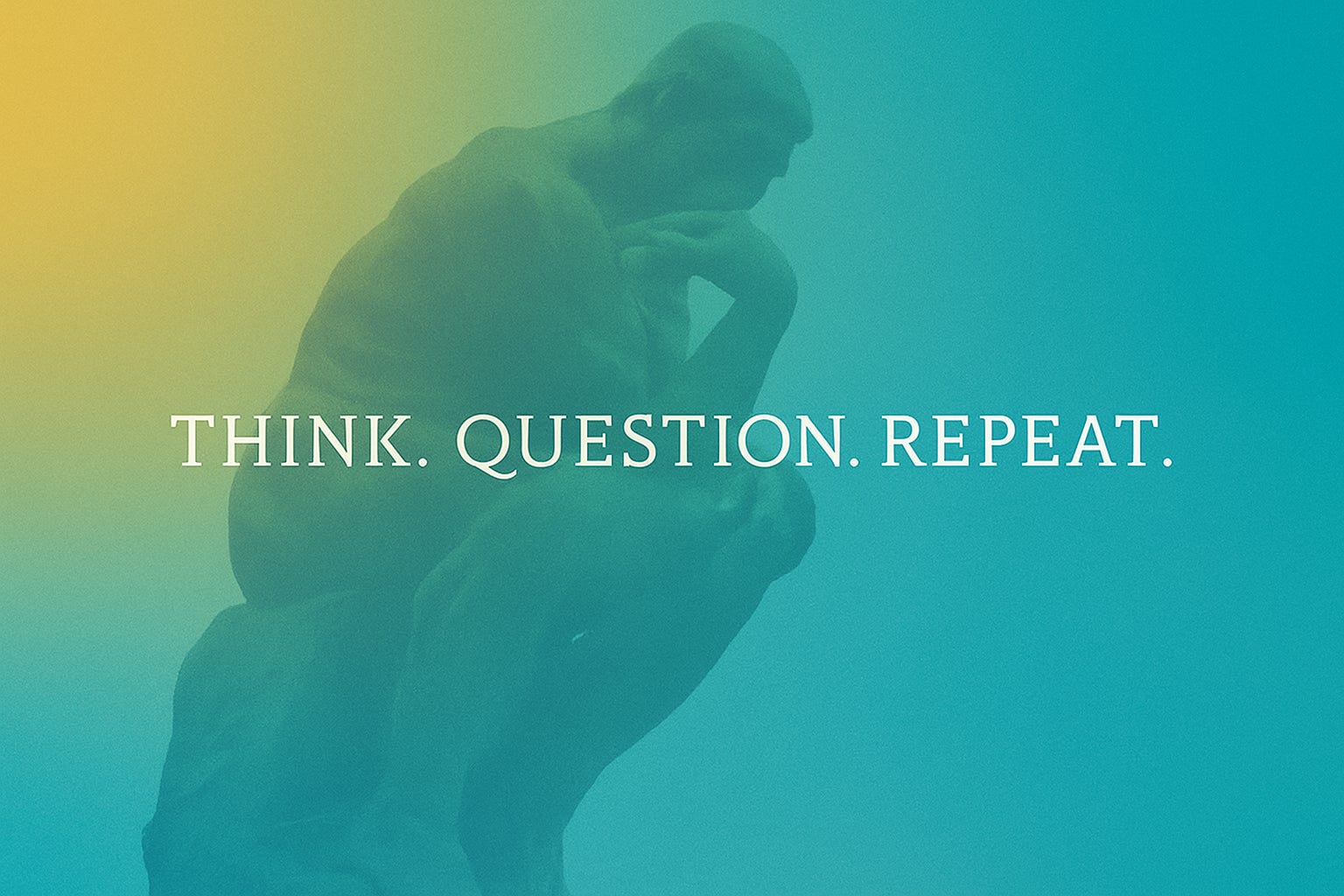
Think. Question. Repeat.
Fighting the Slow Decline of Curiosity, Truth, and Critical Thought in America - and Why It Matters Everywhere
It didn’t start with TikTok. Or Trump. Or the latest culture war flare-up about drag queens and banned books. The dumbing down of America has been a slow, steady decline - decades in the making. Now it’s catching up to us, and the world is watching.
We used to be the country that mapped the human genome, put men on the moon, and built the internet. Now we’re arguing about whether the Earth is flat, whether slavery was “voluntary,” and whether vaccines are some kind of plot.
This isn’t just an American problem. It’s a global liability. When the world’s loudest, most influential democracy forgets how to think clearly, it sends tremors far beyond its borders.
How Did We Get Here?
It didn’t happen overnight. The decline crept in through our schools, our screens, our politics, and even our own habits. If you grew up in the last few generations, you probably remember a time when memorizing facts and not questioning too much was the path to success. Maybe you sat in a classroom reciting multiplication tables or spelling lists. It wasn’t about questioning, just remembering.
But the cracks started showing years ago - budget cuts, test obsession, and a slow drift from learning how to think toward simply learning how to get by. We stopped asking big questions and started chasing easy answers.
A Timeline of Unthinking
The Seeds: 1980s–1990s
“Greed is good” was the motto. Schools saw deep budget cuts. The humanities - history, literature, philosophy - were labeled nonessential. Education became less about nurturing curious minds and more about producing compliant workers.
Meanwhile, talk radio and 24-hour news simplified every problem into a slogan. Nuance and context were the first things out the door. The more outrage, the higher the ratings.
The Surge: 2000s–2010s
Then came “No Child Left Behind,” doubling down on standardized tests. Real learning got squeezed out by bubbling in the right answer. At the same time, the internet exploded, offering up a flood of information - with almost no help in sorting the good from the garbage.
Social media crashed onto the scene, and suddenly, we were all performers, curating our own bubbles and chasing likes. Truth took a back seat to whatever got the most clicks.
The Cliff: 2016–Today
Now anti-intellectualism is on parade. Politicians and influencers brag about “not being an expert.” Facts are up for debate. Book bans and conspiracy theories flourish. News and entertainment have merged - every debate is a spectacle, and every spectacle is a substitute for thinking.
Were We Ever Really That Good at Thinking?
Let’s not kid ourselves. Most of us weren’t trained to be critical thinkers in school. For most Americans, education was about memorization, obedience, and knowing your place. The Ivy League and a handful of small colleges taught debate and inquiry, but for the rest, the goal was to fit in and keep up - not stand out for asking hard questions.
So if you feel like you were never handed the tools to analyze and argue with nuance, you’re not alone. Most of us weren’t. But here’s the catch: the world has changed, and suddenly those old habits just don’t cut it anymore.
“But Look at Everything We’ve Built!”
It’s a fair point. Walk into any store, scroll through your phone, or look up at the satellites circling overhead. As a country, we can do amazing things. We build, fix, and organize at a world-class level. We make decisions every day - at work, at home, in our communities.
But solving technical or practical problems is not the same as wrestling with big questions - questions that ask us to step outside our comfort zone, to reconsider what we “know,” and to listen to each other. We’re great at making things, but as a society, we’re getting rusty at thinking together about why we do what we do - or whether we should do it at all.
When Not Knowing Becomes a Badge of Honor
Somewhere along the line, not knowing - and not caring - became a kind of badge. “I’m not one of those experts,” is a way to win points. Folksy “common sense” trumps years of study. Being skeptical of scientists, journalists, or teachers isn’t just tolerated - it’s celebrated.
This attitude didn’t just appear out of nowhere. America has always had a streak of anti-elitism, but now it’s become a cultural currency. It’s one thing to value real-world experience, but another to shrug off expertise altogether. That’s how we end up with public debates where feelings matter more than facts.
Pop Culture and the Age of Distraction
It’s not just politics or schools. Entertainment is everywhere, all the time. Our days are filled with memes, viral videos, and the latest trending drama. Attention spans are shrinking - everything’s shorter, louder, and designed to keep us engaged for a moment, not a lifetime.
Substance and depth have to fight for scraps of our attention. The news is dramatized, social media feeds on outrage, and thoughtful discussion is pushed to the margins. We’re entertained, but we’re not nourished. When was the last time you watched, read, or listened to something that really made you pause and think?
The Algorithm Runs the Show
Let’s not forget the invisible hand guiding so much of what we see. Algorithms decide what shows up in our feeds - what we click, what we like, what we “should” pay attention to. And those algorithms are tuned to serve us more of the same: the stuff that makes us mad, makes us scared, keeps us scrolling.
That’s why misinformation spreads faster than facts, and why it’s so easy to end up surrounded by people and ideas that only echo what we already believe. The more we let these invisible forces shape our minds, the less practice we get in questioning or stretching our own thinking.
A World Without Shared Reality
Here’s where it all comes together - and where it gets dangerous. Without a shared set of facts, we can’t have a real conversation, let alone fix anything. Each of us lives in a slightly different reality, curated by our own choices and by algorithms that know us better than we know ourselves.
Every argument becomes a battle over the most basic ground: What’s true? What’s real? Without a common reference point, even our best efforts to come together hit a wall.
Do Our Leaders Even Want Us Thinking?
And maybe, just maybe, that’s not an accident. Who benefits from a population that’s easily distracted, easily divided, and easily led? Maybe nobody planned it, but you have to wonder - are we drifting toward a world where questioning is a liability? Where the goal is to create reliable workers, not independent thinkers? Where AI and automation take over, and all that’s left for people is to keep the machine running?
You don’t have to be a conspiracy theorist to see the incentives: a distracted, docile, uncritical public makes things a lot easier for anyone in power, no matter who’s running the show. And if nobody pushes back, that’s exactly what we’ll get.
So, Where Do We Go From Here?
Let’s not sugarcoat it - most of us can’t pick our schools, rewrite the curriculum, or snap our fingers and demand politicians care about truth. Teachers are under the thumb of testing mandates, and online, the noise drowns out almost everything that matters. Deepfakes, fake news, and entertainment disguised as reality make it feel like the deck is stacked against anyone trying to stay thoughtful.
And if you’re a parent? The fight feels even steeper. It’s hard enough to reach your own kids when their world is shaped more by peers, influencers, and online trends than by anything you say at home. The pressure to fit in, to avoid standing out, to go along with the crowd - it’s real. Sometimes, it feels like you’re whispering across a canyon.
For young people just trying to get by, the signals are mixed at best. Work hard, but there might not be a job waiting. Dream big, but don’t expect a house or a stable paycheck. When everything feels uncertain, it’s easy to cling to whatever group or trend promises comfort - even if it means going along with the crowd instead of thinking for yourself.
It’s easy to slip into groupthink. It’s easy to give up and just blend in.
And yet, we can’t just throw up our hands. Maybe we can’t fix the whole system overnight, but there’s still power in the smallest acts of resistance. Don’t share the easy outrage - pause, even just for a second. Ask your kids what they think, and really listen, even when their answers make no sense. If you’re struggling at work, or worried about the future, find one small thing you can do - read, question, reach out - that keeps your mind your own.
We’re not going to turn this around in a year or even a decade. But hope isn’t about guaranteed victories - it’s about not giving in to the tide. Every small refusal to settle for the easy answer, every honest conversation, every act of curiosity - that’s how we start making a dent.
It’s a slow road. But if enough of us keep walking it, maybe - just maybe - there’s a way back.
Think. Question. Repeat.
___________________________
P.S.
🖥️ Click here to return to the Home Page 🖥️
📬 New here? Subscribe for FREE to get future Friday posts straight to your inbox.
🙏 If you find this worth sharing, I’d be honored.
Thanks for reading,
Woodrow Swancutt