
When Power Laughs Under Guard
A photo after violence reveals the widening distance between protected leaders and exposed citizens.
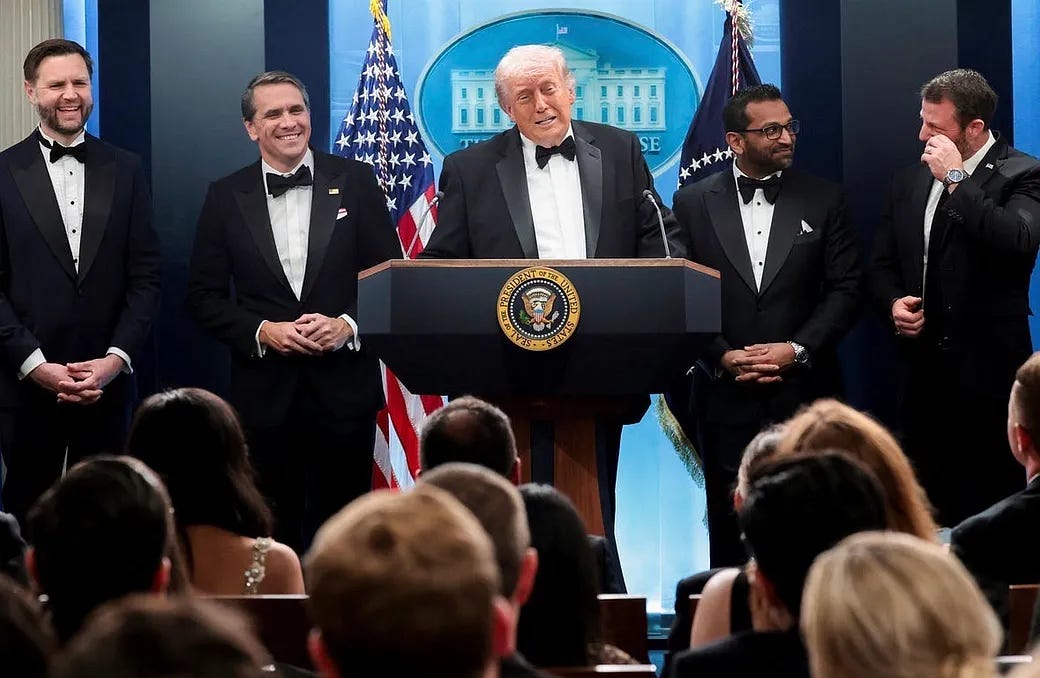
There are photographs that do not tell the whole truth, but still manage to reveal something real.
This one does.
After gunfire disrupted the White House Correspondents’ Association Dinner at the Washington Hilton, President Trump was rushed out by Secret Service, guests took cover, and a Secret Service agent was wounded. The suspect was taken into custody and later charged in federal court. It was serious. It was frightening. It was another entry in America’s growing catalog of public violence, the kind we keep filing away as if the filing cabinet itself were not already on fire.
Then came the image from the White House: tuxedos, flags, podium, seal, smiles, and the old familiar theater of power trying to reassemble itself under bright lights.
And I will say this carefully, because the professional context police are always waiting by the curb with their little whistles. A photograph is a moment. It does not prove what was in anyone’s heart. It does not capture the full conversation before or after. People sometimes laugh after fear. People smile awkwardly. People recover from danger in odd ways.
Fine. Granted.
But the photograph still lands hard.
It lands hard because the men on that stage were safe. They were surrounded by armed protection, emergency plans, locked-down routes, medical response, communications staff, and a whole federal machinery designed to keep them alive. When danger approached, the system moved instantly.
That is not a criticism of protection. Presidents should be protected. Vice presidents should be protected. Public officials should not be shot at, threatened, hunted, or made targets of political violence. A decent society does not celebrate violence against anyone, even when the person under protection has spent years making decency sound like weakness.
But the image reveals the arrangement.
Some people live inside protection.
Everyone else lives inside policy.
That is the part that sticks in the throat. The same political class that can summon armored cars, agents, scanners, secure rooms, and national attention in seconds somehow turns into a committee of budget monks when ordinary Americans ask for protection from gun violence, medical abandonment, school collapse, elder neglect, disability-service shortages, or the slow dismantling of the safety net.
Children in schools do not get that level of protection.
Families waiting for developmental-disability services do not get that level of urgency.
People depending on Medicaid, Medicare, special education, residential supports, mental health care, and home-based services do not get a podium, a seal, and a room full of officials assuring the nation that everything possible will be done.
They get paperwork.
They get denials.
They get waiting lists.
They get “we are reviewing the matter.”
They get the bureaucratic lullaby of a country trying to put them back to sleep.
And then, when they object, they are told to be realistic. The money is tight. The system is complicated. The rules are difficult. The agencies are overwhelmed. The experts are studying it. The legislature is considering it. The task force will issue a report sometime after the people who needed help have worn themselves down to a nub.
Funny how urgency always knows where the powerful people live.
That is what this photograph stirs up. Not merely anger at one smile or one laugh. Something deeper. Something closer to moral nausea.
Because this country has watched children murdered in classrooms and responded with locked doors, clear backpacks, active-shooter drills, and speeches that somehow always manage to end exactly where they began. We have watched families beg for help caring for disabled children and adults, only to be handed waiting lists and cheerful brochures. We have watched rural hospitals close, nursing homes understaffed, teachers burn out, caregivers collapse, and public systems quietly rot behind customer-service language polished smooth enough to skate on.
Then we see power under guard, smiling.
And we are supposed to pretend not to notice the contrast.
The contrast is the whole story.
A wealthy, armed, highly protected governing class can survive the disorder it helps create. That is one of the great ugly truths of our time. They can strip systems down, sneer at public programs, treat social insurance as waste, and lecture the country about toughness - all while standing behind the thickest safety net in America.
Security for them is essential.
Security for everyone else is socialism, waste, fraud, dependency, or some other focus-grouped insult dressed up as budget discipline.
It is a neat trick. Old as dirt, too. The people most insulated from public failure become the loudest experts on what the public should learn to live without. The man with the private guard tells the teacher to manage her classroom better. The man with government health care tells the Medicaid family to tighten up. The man who would never wait ten years for residential support tells the exhausted parent that reform takes time.
Of course it takes time.
Everything takes time when the suffering belongs to somebody else.
That is why the laughter matters, even if we cannot know exactly what produced it. It matters as symbol. It matters as atmosphere. It matters because millions of Americans already feel that the people running the country are not merely making hard decisions. They are making hard decisions for other people and then enjoying dinner afterward.
There is a difference.
Hard decisions shared across a society can be painful but honorable. Hard decisions imposed downward by people floating above the consequences become something else. They become contempt with a policy memo attached.
The most obscene part is not that powerful people are protected. Again, they should be. The obscene part is that protection itself has become a class privilege. The closer you are to power, the more immediate and unquestioned your safety becomes. The farther you are from power, the more your safety becomes a line item, a waiver slot, a grant category, a reimbursement rate, a school board fight, or a prayer request.
That is not civilization.
That is triage with better tailoring.
And it is not only about guns. The shooting is the visible spark, but the larger fire is everywhere. It is in Medicaid cuts dressed up as fiscal responsibility. It is in Medicare anxiety sold as reform. It is in public education being treated like a warehouse for other people’s children. It is in disability services being discussed as if families were asking for luxury upgrades instead of basic human support.
It is in the way America keeps asking ordinary people to absorb instability while leaders remain buffered from it.
Absorb the violence.
Absorb the cuts.
Absorb the shortages.
Absorb the risk.
Absorb the paperwork.
Absorb the fear.
And please do it quietly, because the cameras are on and the men in tuxedos are trying to look steady.
That is why this image feels larger than the event itself. It is not just a photograph of officials after danger. It is a photograph of the bargain Americans are being asked to accept: those at the top receive protection as a matter of national necessity, while those below are asked to prove, document, appeal, wait, and suffer politely.
No one should want leaders unprotected.
But every decent citizen should ask why protection, urgency, and public concern flow so quickly upward - and so slowly downward.
A country tells you what it values by who it rushes to protect.
Right now, too many Americans are watching the people who cut the safety net stand safely inside it. And then they are expected to nod, clap, and admire the composure.
Sorry.
Some of us still have eyes.
_____________________________
______